Glock 19
one of the best-known compact 9mm pistols in modern firearm history
Glock introduced the model as a more compact alternative to the larger Glock 17. Since then, the platform has gone through several generations and design updates.

Glock introduced the model as a more compact alternative to the larger Glock 17. Since then, the platform has gone through several generations and design updates.
Below are several topics that you will learn through this guide about the Glock 19 pistol history, design, specifications, generations, differences, and key similarities. Additionally, the article addresses the points that any responsible gun owner should consider such as safety and maintenance of their firearms as part of being a good responsible gun owner.
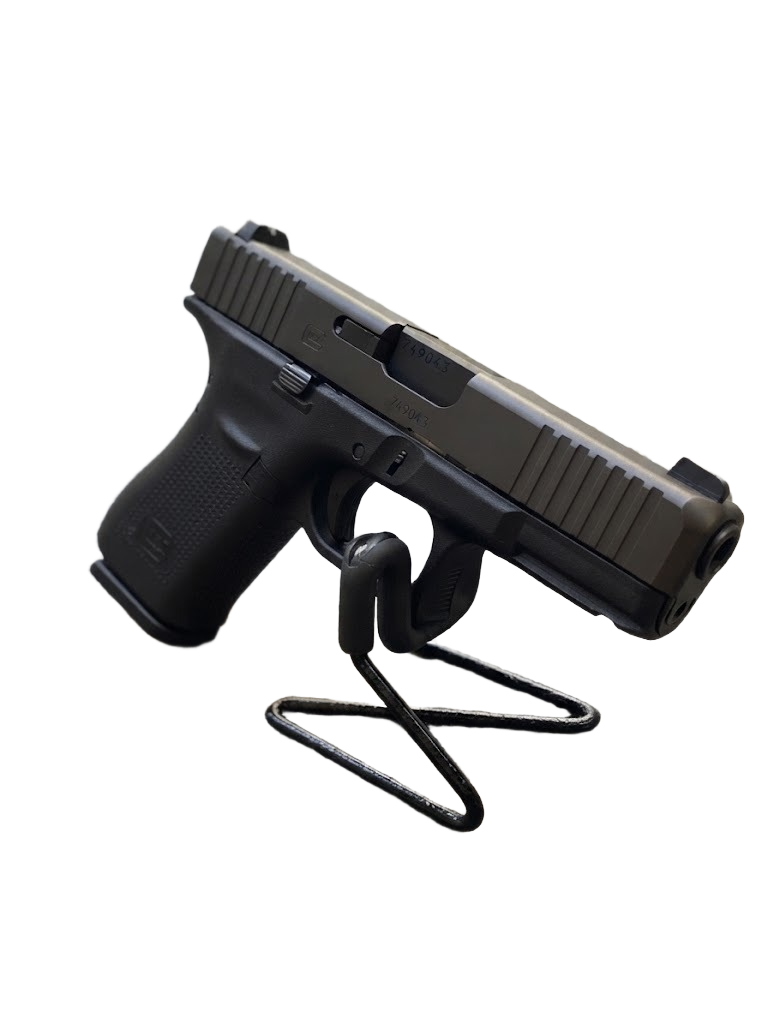
The Glock 19 has been designed from the start to serve primarily the needs of law enforcement personnel where portability is one of the major considerations without sacrificing the reliability and durability. As the result, not only this pistol became a popular member of the Glock pistol family but also has been widely adopted by military, sport shooting enthusiasts and civilian users.
One of the unique features of the Glock 19 is the polyamide (a type of resin) frame which makes the weapon quite lighter without compromising the strength and the resilience
The short barrel makes it very portable and suitable for daily carry without making the user feel uncomfortable carrying a very big and heavy firearm
Being a striker-fired pistol and using a system of short recoil, the overall recoil produced during discharging is less than most other similar pistols. It should be a consideration that the gun would perform quite well without the need for the shooter to use special shooting techniques such as shooting offhand or holding on the gun for a few seconds after each shot
One important part of the design is the implementation of the Safe Action system. This is a triple combination of safety mechanisms (a trigger safety, a safety blocking device and a drop safety) which all working at once or individually to prevent a unintentionale discharge. A more modern version of this feature was called “Safe Action 2”, and is still in use by many shooters as an option of their safety accessories. However, the older versions did not have this feature and thus should not be considered as being equipped with the same level of safety.
Another important part in the pistol is the placement of the magazine release at a location that is easy to reach during the drawing of a gun. This has a major practical value as during an emergency situation, an agent needs to get to their gun as quickly as possible without sacrificing safety by doing it incorrectly. This mechanism has been considered an essential part of a pistol and it was incorporated into some later models with slight modifications which made them more accurate and easier to operate.
.357 Magnum/.38 Spl (5.45 x 39 mm /.447 Revolver)
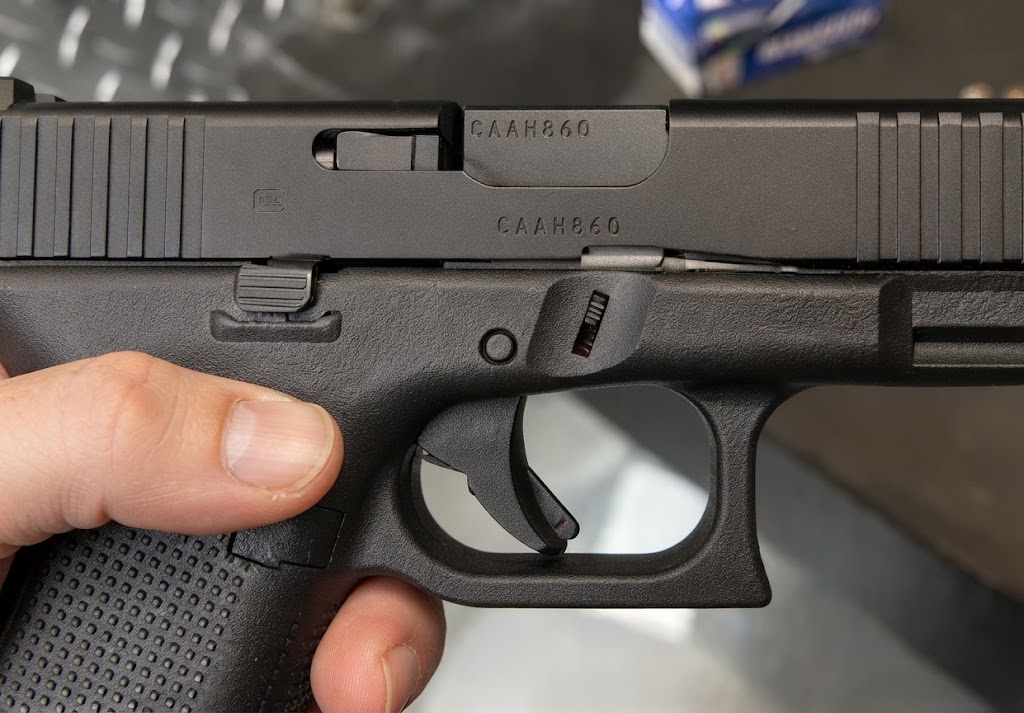
The Glock 19 is a compact version of the much larger and famous Glock 17 semi-auto pistol which itself was a huge success in the market. However the fact that the Glock 19 is the only compact size of the family and yet it maintains most of the features of the much larger model has made it to the top rank of a family series. It has also been adopted in many different ways by the law enforcement, military and even by regular citizens for home defense purposes.
This gun is quite similar in appearance to the larger Glock 17 pistol model. It is chambered in 9mm with an internal striker mechanism. The main differences lie in the fact that the Glock 19 has a polymer grip, whereas the older models had wood grips and the newer ones were even made out of metal. Another big difference is in frame size with the Glock 19 being smaller in comparison to the larger Glock 17. However, it is still quite large for a hand gun so that is a trade off of having more space on the inside.
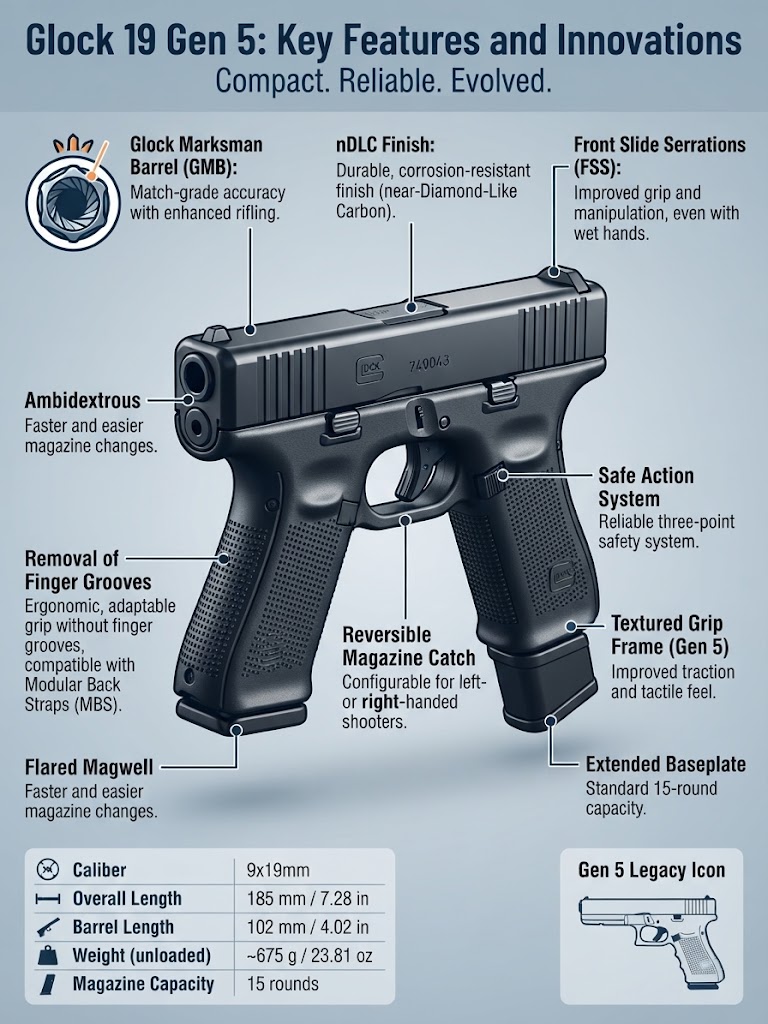
| Feature | General specification |
|---|---|
| Caliber | 9×19mm |
| Operating system | Striker-fired |
| Frame | Polymer |
| Overall length | Approximately 185 mm |
| Barrel length | Approximately 102 mm |
| Width | Approximately 34 mm |
| Height | Approximately 128 mm |
Specifications can vary by generation and configuration. Therefore, readers should consult official manufacturer documentation for the specifications of a particular model.
The Glock 19 has evolved through several generations. Each generation introduced changes to the design, ergonomics, controls, or manufacturing features.
Early Glock production is commonly associated with the first generation of the company’s pistol designs. However, generation terminology for early Glock 19 production can be more complicated than the later Gen 2 through Gen 5 classification.
The second generation introduced changes to the grip texture and overall frame design. These changes provided a more defined gripping surface compared with the earlier pattern.
The third generation introduced several recognizable changes. These included finger grooves, thumb rests, and an accessory rail on the frame.
Gen 3 models subsequently became one of the most recognizable versions of the Glock 19.
The fourth generation introduced several ergonomic changes. One notable addition was the Modular Back Strap system.
The Gen 4 design also introduced a reversible magazine release and additional changes to the recoil system. These updates provided greater flexibility for different users.
The fifth generation introduced further changes to the frame, controls, barrel, and exterior finish. Among the notable changes were the removal of traditional finger grooves, an ambidextrous slide stop lever, and the Glock Marksman Barrel on applicable models.
Because specifications can differ between variants, official documentation should be used when identifying the exact features of a particular Gen 5 model.
The Glock 19 generally falls into the compact 9mm pistol category. However, specifications can vary depending on the generation and configuration.
Commonly published dimensions for standard configurations include:
Caliber: 9×19mm
Overall length: Approximately 185 mm
Barrel length: Approximately 102 mm
Width: Approximately 34 mm
Height: Approximately 128 mm
Frame material: Polymer
Operating system: Striker-fired
When publishing technical specifications, always verify the figures against the manufacturer’s documentation for the specific generation. This extra step helps ensure that published information remains accurate and relevant.
The Glock 19 combines a polymer frame with embedded metal components that support the slide and other operating components.
The steel slide and barrel form the primary metal components of the operating system. At the same time, the polymer frame helps keep the overall weight relatively low.
Furthermore, Glock uses a relatively small number of major components compared with some traditional handgun designs. This streamlined approach contributes to the platform’s distinctive engineering philosophy.
However, different generations feature different components, finishes, and design updates. Therefore, users should not assume that parts will automatically interchange between every Glock 19 generation.
The Glock 19 frequently draws comparisons with other Glock models because several models share elements of the same design platform. Nevertheless, differences in size, configuration, and intended role distinguish each model.
The Glock 17 has a larger frame and a longer slide than the Glock 19. As a result, Glock generally classifies the Glock 17 as a full-size pistol.
By comparison, the Glock 19 has a more compact configuration. Consequently, the two models occupy different positions within the Glock lineup.
The Glock 26 is smaller than the Glock 19 and generally falls into the subcompact category.
In contrast, the Glock 19 has a larger frame and longer barrel. Therefore, the two models offer noticeably different overall dimensions and configurations.
The Glock 45 combines a compact-length slide with a full-size frame. Consequently, its dimensions and handling characteristics differ from those of the traditional Glock 19 configuration.
The Glock 48 uses a slimline design that differs considerably from the wider Glock 19 frame.
As a result, the two models represent different approaches to compact handgun design, particularly in terms of overall frame dimensions.
Safe firearm handling requires consistent attention to fundamental safety principles.
Always treat a firearm as loaded until you have personally established that it is unloaded. In addition, keep the muzzle pointed in a safe direction and keep your finger outside the trigger guard until you have made the decision to fire.
Furthermore, always identify the target and understand what lies beyond it.
Secure storage also plays an essential role in responsible firearm ownership. Store firearms according to applicable laws and the manufacturer’s recommendations, and prevent unauthorized access, particularly by children and other untrained individuals.
Finally, anyone who handles a firearm should seek appropriate professional instruction and follow all applicable laws and regulations.
Routine maintenance should follow the manufacturer’s instructions for the specific Glock 19 generation and configuration.
Before performing any maintenance, consult the official owner’s manual and follow its instructions. If a firearm appears damaged or develops a mechanical problem, seek professional inspection from a qualified gunsmith or authorized service provider.
Moreover, avoid assuming that maintenance procedures or replacement components remain identical across every Glock 19 generation. Instead, verify compatibility and maintenance requirements using the documentation for the specific model.
The Glock 19 is a compact, polymer-framed, striker-fired pistol chambered in 9×19mm.
Glock introduced the Glock 19 in the late 1980s as a compact member of its pistol family.
Glock has produced the Glock 19 across multiple generations. In particular, Gen 2, Gen 3, Gen 4, and Gen 5 have extensive documentation. Early-generation classifications, however, require additional historical context.
Each generation introduces various changes to the pistol’s design. These changes include grip texture, ergonomics, controls, recoil-system components, barrel design, surface treatments, and other manufacturing features. Therefore, buyers and researchers should check the specifications for the specific generation they are examining.
The Glock 19 has a more compact design, whereas the Glock 17 has a larger frame and longer slide. Consequently, the two models differ in their overall dimensions and handling characteristics.
The Glock 19 features a polymer frame, striker-fired operating system, and Safe Action system. In addition, each generation incorporates its own ergonomic and mechanical updates.
A commonly published standard configuration measures approximately 185 mm in overall length, 102 mm in barrel length, 34 mm in width, and 128 mm in height. However, dimensions can vary depending on the generation and specific configuration. Therefore, always check the manufacturer’s specifications for the exact model.
Glock 19 owners should follow fundamental firearm-safety rules, use secure storage, obtain appropriate training, and comply with all applicable laws. Furthermore, owners should consult the manufacturer’s safety information and follow local requirements.
Owners should follow the official manufacturer’s maintenance instructions for their specific Glock 19 generation and configuration. In addition, they should consult the appropriate owner’s manual whenever they need model-specific maintenance information.
The manufacturer’s official documentation provides the most reliable source for current specifications, owner’s manuals, safety information, and model-specific details. Therefore, readers should consult official documentation whenever they need precise or current information.
The Glock 19 has evolved through several generations while retaining many characteristics associated with Glock’s overall design philosophy.
Over time, Glock has introduced changes to ergonomics, controls, materials, and manufacturing while maintaining the platform’s recognizable design. As a result, each generation offers useful points of comparison for researchers and enthusiasts.
For anyone researching the Glock 19, comparing individual generations provides valuable historical and technical context. However, specifications can vary between models and production configurations. Therefore, readers should always consult official manufacturer documentation when they need precise information.